1.3 Managing Emotions
On this page
- Model with Four Emotions
1.1 Moods and Spoken Language
2.2 Baseline Emotion
1.3 Flexibility with Emotions - Classroom with attic and basement
2.1 Chest of drawers – Memory and Empathy
2.2 Alarm
2.3 From the Attic to the Classroom
2.4 From the Basement to the Classroom - Regulating Emotion During Whole-class Teaching and During Independent Work
- Strict, friendly or friendly and fair?
4.1 Friendly and Fair Reïnforcing Positive Behaviour - Examples
- Summary
- Credits
Teachers regulate their emotions. In doing so, they create calm. Pupils adopt their attitude.
When I teach and guide behaviour in a friendly and fair way, without becoming emotionally unbalanced, my own unrest disappears — and so does that of my pupils.
The world is like a mirror: look into it angrily and it looks back angrily; smile, and it smiles too.” (Herbert Louis, 1st Viscount Samuel)
He who cannot become angry is a fool; he who will not is wise.” (Seneca)
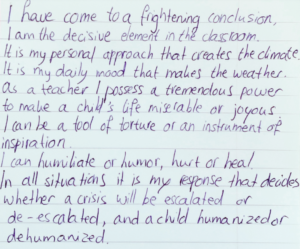
Haim Ginott
Introduction video
For more information check out our other introductory videos here.
Current approach:
How do I manage my emotions now?
Future approach:
How do I manage my emotions in the future?
Introduction
‘Managing Emotions’ is one of the four modules within the ‘Friendly’ perspective of Friendly and Fair Teaching (FFT).

Figure 7: Establishing a friendly tone (overview)
If you become angry when overstimulated, you may temporarily bring pupils into line, but the atmosphere suffers — and you end up exhausted.
FFT therefore advises responding to stimuli calmly. By regulating your emotions, you create a sense of calm. Your pupils will adopt your attitude.
Two models follow. The first model distinguishes four emotions. The second model shows how you see those emotions reflected in the classroom. With this second model, VOH provides guidance on how you, as a teacher, can influence emotions.
1. Model with Four Emotions
This model, developed by VOH, represents emotions as four animals. These animals symbolise four possible emotional states that both teachers and pupils can experience. The model helps you to map these emotions without judging them. It supports you in recognising your own emotions as well as those of your pupils.
If you are able to switch between these four emotional states, you will connect more effectively with your pupils and help them gain experience in recognising and managing a range of emotions.

Figure 24: 4Moods Axis system
The x-axis represents movement: calm on the left, active on the right.
The y-axis represents energy: heavy at the bottom, light at the top.
This results in four emotional states:
Unicorn → creative, relaxed (calm and light)
Owl → thoughtful (calm and heavy)
Puppy → energetic, playful, cheerful (active and light)
Woodpecker → intense, powerful (active and heavy)
1.1 Emotions and Language Use
Emotions are reflected in the way pupils speak to one another. Therefore, pay attention to how they speak, and also to your own language. If a pupil expresses themselves in an inappropriate way, address this.
Harsh language is more likely to occur in the woodpecker state (active and heavy) than in the unicorn state (calm and light).
For more information, see Observing Language Use.
1.2 Baseline Emotion
Everyone has a baseline emotional state with a corresponding level of energy. Some people are usually calm, while others are naturally more active. Some tend to be dreamy, while others are more playful.
1.3 Flexibility with Emotions
To influence the emotional state of a group, it is essential that you can switch between the four emotional states yourself.
2. Classroom with Attic and Basement
The previously described model with four emotions has been combined by FFT with the Mateshouse model. In this adapted version, FFT places the four animals representing emotions within a classroom setting.
This model illustrates how you can regulate both your own emotion and those of your pupils during a lesson.

Figure 25: Classroom with basement and attic
Everyone in the classroom can shift between the four emotional states. In practice, at any given moment, you may observe four groups of pupils:
- pupils showing the unicorn emotion
- pupils showing the owl emotion
- pupils showing the puppy emotion
- pupils showing the woodpecker emotion
Key Features of the Model
This model shows that pupils are able to concentrate when a lesson is well-managed. If you display the owl emotion, you help pupils in the woodpecker state to calm down.
- The classroom contains:
– groups of pupils (represented as animals),
– a chest of drawers,
– an alarm system.
The classroom represents the ground floor, where emotional regulation takes place. Pupils can enter and leave (with your permission). - The chest of drawers represents memory and empathy.
- The alarm signals conflict.
- The attic represents a state of too much energy (fight/flight), where memory and empathy are impaired.
- The basement represents too little energy (freeze/faint), where memory and empathy are also impaired.
For effective learning, pupils need access to their memory. This model shows how important it is to prevent pupils from moving into the attic or basement.
Why should you regulate your energy? In this video, see what happens to students when their teacher is angry. You’ll also see how by consciously displaying a mood, you can improve your teaching.
2.1 Chest of Drawers – Memory and Empathy
The classroom represents a safe and comfortable environment. When pupils feel at ease, they are able to:
- use their memory effectively.
- show empathy towards others.
2.2 Alarm
In the event of a conflict, the alarm is triggered for everyone. This may occur between pupils or when a teacher responds in an angry or harsh way.
In such situations, pupils may move:
- to the attic, or
- to the basement.
In both cases, memory and empathy are impaired.

Figure: two options
2.3 From Attic to Classroom
To release excess energy and return to the classroom:
- breathe calmly,
- meditate,
- use calming music or sounds.
2.4 From Basement to Classroom
To increase energy and return to the classroom:
- use energisers,
- engage in movement,
- use dance and music.
3. Regulating Emotions During Whole-class Teaching and During Independent Work
During Whole-Class Teaching
You set the energy level of the group. Pupils tend to mirror your energy.
If the class is restless, do not mirror this—remain calm.
During Independent Work
You lower the energy level so that pupils can work in a calm environment. You:
- speak softly and set the example.
- only speak to a pupil when you are close to them.
- observe.
- act visibly.
- decide when to let things run their course (teaching is the art of gradually letting go).
- give compliments using gestures (thumbs up).
- address disruptions using body language first, then Tips, and if necessary a Letter about future behaviour.
4. Strict, Friendly or Friendly and Fair?
Strictness may stem from fear or a need to create distance. Being only strict is ineffective.
Being only friendly may stem from a reluctance to give direction. Being only friendly is also ineffective.
FFT therefore advocates being both friendly and fair.
4.1 Friendly and Fair Reïnforcing Positive Behaviour
Instead of being overly strict, you set boundaries in a friendly and fair way. When addressing a pupil on behaviour or commitment, you avoid reacting impulsively.
The first steps act as a buffer, meaning that stronger measures (such as writing a letter) are rarely needed. By remaining calm and following consistent steps, you maintain a positive relationship with your pupils.
When a disruption occurs:
- First address it using gestures (non-verbal guidance),
- If needed, give a positively phrased Tip,
- Do not mirror negative behaviour,
- Remain calm, breathe steadily, stand upright and move slowly,
- Give compliments when things go well,
- Stay positive. Pupils will notice that you resolve disruptions calmly.
The combined advice is: be both friendly and fair. This is effective and energy-efficient.
5. Examples
Quotes
What might help is a Stoic response:
But if you keep the disticntion between speech and violence, then many more options are available to you. First you can take the Stoic response and develop your ability to remain unmoved. As Marcus Aurelius advised: Choose not to be harmed – and you won’t feel harmed. Don’t feel harmed ‘and you haven’t been…….The Stoics understood that words don’t cause stress direcly; they can only provocke stress and suffering in a person who has interpret a visiting speaker as harmful. You canpick your battles, devote your efferts to changing policiesthat matter to you, and make yourself immune to trolls.” Lukianoff (2018), Greg en Jonathan Haidt
The problem is not what happens, or what setbacks you experience, but how you deal with them” (Fundamental Principle of Stoicism).
Giving air to anger and to let it pass, is as effective as using gasoline to extinguish a fire.’ This quote is from Brad J. Bushman. He took it to the test. He angered no less than 1,600 subjects. Immediately afterwards, half of them were given a punching bag to beat out their anger. Without exception, they became even angrier. Angry behaviour only makes you angrier, with more and more hormones coursing through your body. Much better to do something else: pet your cat or count to ten. One hundred is even better. After that you won’t need the [boxing] ball anymore.” Dekker (2006), Midas
Heart Rate App
“Measuring is knowing”: with a smartwatch and app, you can monitor your heart rate and see how well you regulate your emotions during teaching. A consistently high heart rate is exhausting and leads to fatigue.
Translating Emotions into Music
For musicians, the four emotions can be translated into musical instructions:
Calm + light (Unicorn)
Few notes – slow tempo – very soft (pp) – major
Calm + heavy (Owl)
Rubato or slow tempo – few notes – soft (p) – minor
Active + light (Puppy)
In time – lively tempo – many notes – strong (f) – major
Active + heavy (Woodpecker)
Rubato or virtuosic – many notes – very strong (ff) – minor
These musical transformations have been developed into an app called Moods, which allows you to do all kinds of exercises involving dance, language, or music. Participants respond to the changing ‘Moods’. These examples of mood programs can be found in the Scratch program under the name Rapucation (see name change to FFT). On the Scratch site: https://scratch.mit.edu/, enter ‘rapucation’ in the search bar.
You can also open this program directly, which allows you to switch between different emotions. Four different songs are hidden within that single program.
Watch this video in which Wietske Tijssen explains how she uses the ‘cool down’ effect to start the session with her primary school students after recess.
What is the connection between emotion and the way you speak? In this rap song, Cool down (i.e., a decrease in energy), a rapper uses his voice in an increasingly calmer manner.
What is the connection between tempo and relaxation? Listen to the album ‘Classic Slowdown’ by the Conductors Band on Spotify. This music is specifically intended to help children fall asleep.
6. Summary
The Classroom with Attic and Basement model describes four emotional states and shows how anger disrupts both you and your pupils.
When angry, you move to either a state with too much energy or a state with too little energy. Lessons improve when you can switch between emotional states and, where possible, avoid anger.
A Stoic approach can help: you choose not to feel immediately offended, allowing you to remain in control of your response.
7. Credits
| Darren Abrahams and Celina Souza |
During a Train the Trainer course by Musicians without Borders in Ede (Netherlands), Darren Abrahams explained the Mateshouse model, originally based on a living room setting. FFT adapted this into a classroom model to show the importance of a friendly teaching approach. See: http://matesbrainregulationprogram.com/ |