1.2 Communicating Through Gestures as well as Language
On this page
Students pay closer attention when teachers give instructions using body language.
I give friendly and silent instructions using body language. Wherever possible, I replace verbal instructions with clear, unambiguous gestures. As a result, students pay closer attention and all focus remains on the lesson content. When I teach, I communicate in two ways simultaneously:
- Verbally, I provide explanation
- Throug body language, I give instructions
Introduction video
For more information check out our other introductory videos here.
Current approach:
What instructions have I used so far through body language?
Future approach:
What instructions will I use through body language in the future?
Introduction
‘Communication through gestures as well as language’ is one of the four modules within the ‘Establishing a Friendly Tone ’ perspective of Friendly and Fair Teaching (FFT).

Figure 7: Establishing a friendly tone (overview)
With this module, you give instructions silently using body language. You speak less, allowing the lesson content to take centre stage.
On this website, body language is addressed in three places:
- This page focuses on simple gestures in situations where the lesson runs smoothly and students are cooperative.
- If a student disrupts the lesson or shows insufficient effort, see: Non-verbal guidance – step 1 (Guiding and Adjusting). Behaviour or effort is then guided using a sequence of three gestures.
- More general information about body language can be found under ‘Using body language’.
Gestures help you maintain contact, even in a noisy environment. By not raising your voice, you remain calm and set a positive example. Gestures also work at a distance (sometimes even better than speech).


1. Silence gesture
2. Attention gesture – Attention everyone
3. Lighthouse gesture (video)
4. Start gesture – Everyone starts




5. Stop Gesture – Everyone stops
6. Lower volume gesture –
Everyone lower volume
7. Transition from independent work
to whole-class teaching (video)
8. Compliment
If you find gestures and body language effective, create your own gestures for other situations. This will make your teaching increasingly efficient.
1. Getting Started with Body Langguage Instruction
If you are not yet used to consciously using gestures while teaching, for example because you feel uncomfortable, FFT recommends starting with the eighth gesture: the thumbs-up as a compliment. When students respond quickly—for example when switching activities—show the whole group that you appreciate this. Raise both thumbs. (You can also give a compliment with a nod and an appreciative look.)
Below are eight examples of silent instructions. Click on a gesture for more information.
2. Applying body language instructions
The use of body language varies depending on the situation. During whole-class teaching, it is used slightly differently than during independent work.
First, some general guidelines that apply to both:
2.1 Guidelines for Both Whole-Class Teaching and Working Independently
- You can direct a gesture at one student or at the whole group.
- Make eye contact. Keep your gaze relaxed, neutral and friendly.
- Gestures are effective for simple instructions. If used consistently in similar situations, they are clear and improve concentration.
- You can vary gestures in size—large or small. Aim to achieve the desired effect with the smallest possible gesture.
- Visual aids can also be used to give silent instructions.
- Verbal instructions can be replaced by images or a sound, such as a bell.
- Choose your position in the classroom deliberately; it influences both your gesture and your explanation.
- Use facial expressions. Note: students with autism spectrum conditions may find facial expressions harder to interpret, but clear gestures are generally well understood.
- People tend to mirror each other’s body language. Use this to your advantage. If the group is restless, remain calm. If the group is passive, energise your students. Adjust your level of energy to the situation (see Regulating your Emotions).
2.2 Different approach to whole class teaching or working independently
Your posture and use of gestures differ depending on the teaching format. Below, the approaches are outlined separately.
Body Language During Whole class Teaching

Inspiring Students
You present the subject matter and lead the class discussion in a way that appeals to the pupils. You connect with the pupils’ world of experience and focus your teaching on expanding their world of experience. Read more under ‘Planning lessen’ about the roles of a teacher: Tour Guide
You have a central, visible role (Genie out of the bottle). You speak clearly and thereby implicitly convey the message: “Pay attention to me.” Adopt an expressive posture during frontal teaching. If you stand confidently with an open attitude, students are more likely to take you seriously.
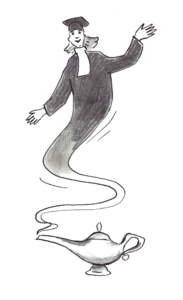
Image: Genie out of bottle
Figure 102: Genie out of the bottle
An Effective Gesture – Cold Calling
See more on this topic at Exquisitiveeducation.
- During a class discussion, use the start gesture to select a student to answer (cold calling). Ask students not to raise their hands. You choose who responds.
If a student does not know the answer, invite another: “Can you help?” If needed, ask: “Who can help?” Students’ expressions will show who is willing. This works better than asking “Who knows?”, as that may unintentionally make the first student feel inadequate. - You can also use the start gesture to invite a student to participate in an activity following your explanation.
Starting Your Explanation
If you want the group’s attention and students are talking, this does not mean they are unwilling to begin. The way you ask for attention sets the tone. Use a gesture (such as the lighthouse gesture) to create calm and start the lesson smoothly. Any discomfort with using gestures can be reduced by encouraging students to use them as well.
Body Language During Independent Work

Invisible Coaching
During independent work, you coach your students in a subtle, almost invisible way. Most students do not notice your instructions because you direct your body language at individuals or small groups. For others, you are almost “in the bottle”—not present.
An observer entering the classroom would need to look carefully to find you, as you make as little noise as possible. By acting as quietly as possible, you give each student the space to take initiative.
See ‘Planning Lessons‘ for more about your role as a teacher: Roadside assistance (supporting students when they get stuck).

Figure 101: Genie in the bottle
When you have eye contact with a student, your instruction works even at a distance—similar to sign language. Verbal instructions at a distance would require raising your voice and would disturb others. By using body language, you allow every student to work with concentration.
Examples
- If a student raises their hand and looks at you, you either walk over or signal them to come to you. Once close, you speak quietly so others can continue working undisturbed.
- If students are working silently and time is nearly up, you can signal this by handing out materials.
- To end independent work, use the gesture: Transition from independent work to whole-class teaching
3. Examples
Communication through gestures provides clarity and calmness. As a result, your students can concentrate better and you teach in a relaxed manner.
Josie uses the lighthouse gesture (she calls it the “silence sign”):
“When I use the silence sign, students respond strongly, and that still surprises me.”
Annemiek, who has worked as a workshop leader and as a lecturer in higher education, says:
“With this gesture, students share responsibility for maintaining silence in the classroom. Silence becomes a shared responsibility. There is no longer any need to ‘play the police officer’.”
4. Summary
By combining body language and speech, you create clarity and calm. Students pay better attention and can concentrate more effectively. You teach in a relaxed and confident manner.