6.3.1 Using Gestures
On this page
- Introduction
- Communication through gestures as well as language (Perspective Estabishing a friendly tone)
2.1 Silence gesture- Ask a pupil to stop talking
2.2 Attention gesture – Attention Everyone- Ask a pupil or a group to pay attention
2.3 Lighthouse gesture – Ask the entire group to pay attention
2.4 Start gesture – Everyone starts – Ask a pupil or a group to start with something
2.5 Stop gesture – Everyone stops – Ask a pupil or a group to stop with something
2.6 Softer gesture – Everyone lower volume – Ask a pupil or a group to make less noise
2.7 Switching from working independently to whole-class teaching
2.8 Compliment (thumbs up) - Non-Verbal reinforcing positive behavriour (Behaviour Management Strategies – First steps)
3.1 Stop talking – First series of three gestures
3.2 Stop disturbing – Second series of three gestures
3.3 Start working – Third series of three gestures - Summary
- Credits
Teachers communicate in a friendly manner using both gestures and language. On the one hand, teachers give instructions through gestures, which helps the lesson to run more smoothly. On the other hand, they use series of gestures as the first step of reinforcing positive behaviour.
During my explanations, I use gestures to help the lesson run more smoothly. I also use series of gestures to address a pupil on behaviour or commitment.
1. Introduction
A number of gestures have been selected by FFT for use in every type of lesson. These gestures are divided into:
- Single gestures that help the lesson run more smoothly (Communication through gestures as well as language).
- Series of gestures that you use to address a pupil non-verbally about their behaviour or commitment (Behaviour Management Strategies – First Steps).
2. Communication through gestures as well as language
By using (silent) gestures, you help your lesson run more smoothly. Because these cues are non-verbal, pupils’ attention remains focused on the content of the lesson.
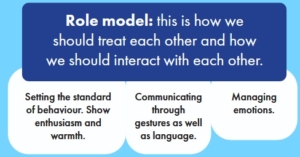
Figure: Role model (see Overview)
2.1 Silence gesture – Ask a pupil to stop talking
With the Silence gesture, you ask a single pupil to stop talking. The origin of this gesture is explained in the Credits section.
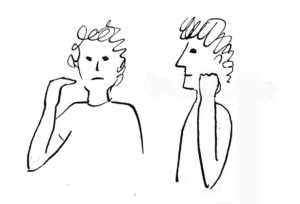
Figure: Silence
2.2 Attention gesture – Attention everyone – Ask a pupil or the entire group to pay attention
Attention gesture
With this gesture, you ask for the attention of a single pupil. You then expect the pupil to stop talking, sit still, and look at you.
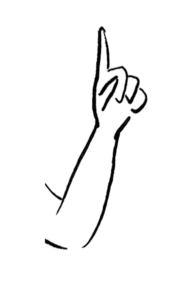
Figure:Attention
Attention all
Ask the entire group to pay attention

Figure: Attention all
2.3 Lighthouse gesture – Ask the entire group to pay attention
With the Lighthouse gesture, you ask the whole group for attention. You are not only asking pupils to stop talking; you are also asking them to look towards you and sit still. Only once you have the group’s attention do you start a whole-class discussion or begin your explanation.
While making this gesture, you rotate your upper body and look at everyone one by one. Let your gaze move across the group, like the beam of a lighthouse sweeping across the horizon. As you turn, do not fix your eyes on a single pupil. Depending on the situation, take three to six seconds for this movement: three seconds is sufficient for a calm group, while a busier group may require up to six seconds. This ensures that everyone has seen the gesture, and those who have not will hear the room becoming quieter.
Read more about the origin of this gesture in the Credits section.
Alternative gestures to ask a group for attention
- With one hand you hold an erect index finger by your lip. With your other arm, with your arm extended, make the Attention gesture from left to right until you have looked at everyone.
- Make with both hands the Attention gesture.
- Make the gesture an officer makes to get you to stop. Combine this with an upright index finger in front of your lips. Again, look from left to right until you have looked at everyone.
2.4 Start gesture – Everyone starts – Ask one pupil or the entire group to start with something
Start gesture
With this gesture, you ask a single pupil to start doing something. You make the Start gesture by moving your open hand (palm facing upwards) forwards. The meaning of the Start gesture depends on the context. You can use this gesture to ask pupils to carry out different actions:
- Go ahead.
- You may begin.
- Would you like to sit down?
- Would you like to show what has been asked?
You also use the Start gesture to ask a pupil to begin working. Later on this page, the Start gesture appears as part of a series of three gestures used to reinforce positive behaviour (Behaviour Management Strategies: First Steps).
Start all
With this gesture, you invite the entire group to begin doing something, depending on the context.
2.5 Stop Gesture – Everyone stops – Ask one pupil or the entire group to to stop
Stop gesture
With this gesture, you ask a single pupil to stop doing something.

Figure: Stop gesture
Stop all
With this gesture, you ask the entire group to stop doing something.

Figure: Stop all
2.6 Softer gesture – Everyone lower volume – Ask a pupil or the entire group to make less noise
Softer gesture
With this gesture, you ask one pupil to make less noise or to speak more quietly. Hold one arm slightly extended, with your hand at head height and your palm facing downwards, and slowly move your arm downwards.
Softer all
Use both arms to ask the whole group to lower their volume.
These gestures comes from the practice of orchestral conducting. It helps you avoid the loud and familiar “shhh” sound.
2.7 Switching from working independently to whole-class teaching
With the gesture you use to switch from independent work to whole-class teaching, you do use your voice. There is a clear reason for this: when pupils are fully engaged in independent work, they should not be paying attention to you. If you want to communicate something to everyone during independent work, it is best to combine a large, slow gesture with the use of your voice. This makes it completely clear to all pupils that you are addressing the whole class.
In the video the teacher says in Dutch: “Everybody clean up and sit in the circle”.
2.8 Compliment
- The thumbs-up gesture is a very effective way to show that a pupil is working well. If you are not yet convinced of the power of gestures, start with this one. This gesture allows you to give a compliment without naming a pupil. When you give a verbal compliment and mention a name, another pupil may think, “They’re getting a compliment and I’m not. Am I doing something wrong?”
- If you want to compliment the whole class, make the same gesture with both hands.

Figure: Compliment
3. Non-Verbal reinforcing positive behavriour (Behaviour Management Strategies – First steps)
If you want to address a student’s behaviour or commitment, use a series of gestures. This series of gestures keeps everyone’s attention focused on the lesson and minimizes disruption. For each situation, choose one of these three sets of gestures as the first step in addressing a student.

Figure: non-verbal reinforcing positive behaviour
Communication process
Each series forms a communication process consisting of three gestures. Addressing a pupil then has a beginning, a middle and an end.
- You start the communication by asking for attention using the Attention gesture.
- Next, you make a gesture to indicate what you want: Silence, Stop, or Start.
- Finally, if the pupil does what you ask, you complete the communication process with the Compliment gesture. With this gesture, you thank the pupil for their cooperation.
In most cases, pupils respond well to these gestures. If a pupil does not, you give a ‘Tip’, which is step 2 of ‘Behaviour Manamgent Strategies‘.
3.1 Stop talking – First series of three gestures
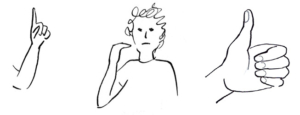
Figure: serie 1 stop talking
With this series of gestures, you ask a pupil to stop talking.
If the pupil does not stop talking, you omit the compliment and it is time to give a Tip and record it, for example: “Please pay attention.”
3.2 Stop disrupting – Second series of three gestures
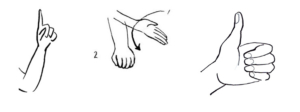
Figure: serie 2 stop
With this series of gestures, you ask a pupil to stop a specific behaviour, such as:
- moving around
- touching another pupil
- making noise
- using inappropriate language
If the pupil does not stop, you omit the compliment and it is time to give a Tip and record it, for example: “Please sit still.”
A variation on this series:
Move your index finger slowly from left to right. This asks a pupil to stop what they are doing. If the pupil does not respond, you can reinforce the gesture by slowly shaking your head at the same time.
3.3 Start working – Third series of three gestures
With this series of three gestures, you ask a pupil to start working during independent work, or you invite a pupil to take part in an activity during whole-class teaching.
If the pupil does not start working, you omit the compliment and it is time to give a Tip and record it, for example: “Please start working.”

Figure: serie 3 start
4. Summary
During your explanation, you use gestures to help the lesson run smoothly. You also use series of gestures to address a pupil’s behaviour or commitment. When you use these gestures in a friendly manner, they contribute to a positive learning environment. Becoming angry while Directing, when addressing a pupil’s behaviour or engagement, is not necessary when using these gestures.
5. Credits
Maarten ‘t Hart
The father of Johan ’t Hart, Maarten ’t Hart, was a traffic engineer (see the video Johan made about his parents – the writer Maarten ’t Hart is not related). During the Second World War, Maarten was in hiding. At that time, he wore a pin depicting a broken rifle.
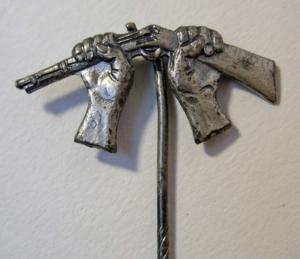
Figure: broken rifle
This pin symbolised pacifism and later also inspired the Silence gesture. With this gesture, you ask one pupil for silence. To ask an entire group for attention, the ‘Lighthouse gesture’ was developed, incorporating the ‘Silence gesture’ .