
Introduction: Behaviour Management Strategies
On this Page
- Metaphor: Driving Licence – Gradual Braking – Traffic Lights – Chain
- Six Components of Behaviour Management Strategies
- Start with Behaviour Management Strategies in two periods
- Addressing a Student or the Group on Behaviour and Commitment in Four Situations
4.1 Table Approaches to Teaching / Addressing Behaviour - Time Investment in Behaviour Management Strategies for Teacher and Student
- Astrid Boon – Importance of Order
- Examples – Good Practice
7.1 Short Version of Behaviour Management Strategies - Summary
- Credits
Pupils quickly recognise whether a teacher is able to maintain order. A teacher who can maintain order acts deliberately, observes carefully, prepares lessons thoroughly, and has a clear strategy for dealing with classroom disruption (Behaviour Management Strategies). This teacher addresses pupils efficiently about their behaviour and commitment. Friendly and Fair Teaching (FFT) supports teachers in developing a strategy.
With Friendly and Fair Teaching (FFT), I address pupils on behaviour or commitment first non-verbally and verbally and then by taking action. The way I address pupils is increasingly friendly, clear and effective.
Introduction Video
For more information check out our other introductory videos here.
Current Approach:
How do I manage behaviour now?
Future Approach
How do I address a student on behaviour and commitment in the future?
Introduction
‘Behaviour management strategies’ is one of the five perspectives of Friendly and Fair Teaching (FFT)
Video with Information for Teachers about Behaviour Management Strategies

Image 81: Behaviour management strategies (overview)
Before you start teaching, you form a clear picture of how you want your lessons to run in the future: friendly and fair (the Framework). You have a clear idea of what you expect from your pupils (Triangle) and you determine a strategy for addressing pupils’ behaviour or effort (Behaviour Management Strategies).
Teaching and addressing pupils’ behaviour and commitment are closely connected. From experience, teachers know that order does not arise automatically. Interaction, cooperation, conversations with pupils and careful reflection by the teacher are prerequisites for order in the classroom.
Developing a personal style for addressing pupils’ behaviour and effort is often a lengthy process, involving trial and error. If addressing pupils continues to feel difficult, teaching can quickly start to feel burdensome. This chapter supports you in addressing pupils efficiently and effectively.
Behaviour Management Strategies is part of teaching. When addressing a pupil’s behaviour or commitment, FFT distinguishes three steps. FFT advises applying these steps in a friendly and clear manner:
- Non-verbal (Addressing a puil’s behaviour within boundaries – Behaviour Management Strategies: First Steps)
- Verbal (Addressing a puil’s behaviour within boundaries – Behaviour Management Strategies: First Steps)
- Action (Addressing a pupil’s behaviour outside boundaries – Behaviour Management Strategies: Next Step)
These three steps are presented within Behaviour Management Strategies as a proposal. This proposal, too, can be refined. At any time, you can try out one of FFT’s suggestions, adapt it and integrate it into your existing way of teaching.
You have probably already developed your own ways of addressing pupils non-verbally or verbally, and you likely already use take action to correct a pupil who does not respond adequately. With this fifth chapter, we offer you the opportunity to make your approach to Behaviour Management Strategies gradually more friendly. This helps prevent moments where you angrily exclaim “I’ve had enough” and then resort to handing out punishment work or sending a pupil out of the classroom.
With Behaviour Management Strategies, you ensure that you maintain positive relationships with your pupils, that they pay attention when you explain something, that classroom discussions proceed without disruption, and that pupils work independently. As a result, learning outcomes improve.
FFT advises introducing these three steps as a coherent whole at the start of a new school year during the ‘Practice Period’. Once you are accustomed to this approach, you can further refine it by introducing the ‘Abacus’ (Introducing the Abacus).
For both you and your pupils, being friendly and remaining friendly is an aspiration: the outcome of a shared learning process that takes time. It is a way of working that requires commitment and adjustment from both teacher and pupils.
More information from FFT about ‘Behaviour Management Strategies’
To explore this perspective further, FFT provides information in the following sections:
- Behaviour Management Stratiegies: First Steps – first non-verbal, then verbal
- Behaviour Management Strategies: Next Steps – addressing a pupil with an effective measure
- Practice Period – during this period you address each pupil individually regarding behaviour or commitment using ‘Gestures‘ and ‘Tips‘, and you introduce the ‘Framework‘ and the ‘Triangle‘.
- Introducing the Abacus – after the ‘Practice Period‘, you may choose to address not only individual pupils but also the group as a whole. You then reduce the number of disruptions with two boundaries.
- Complete Guide to Behaviour Management Strategies – used once you have completed the ‘Practice Period‘ and introduced the ‘Abacus‘.
- Behaviour Management Strategies: Instructional Videos
Whether you teach the whole class or allow pupils to work independently, both teaching formats require an approach that enables everyone to concentrate and apply themselves effectively. FFT presents information per teaching format in two columns:
- on the left: Teacher-centred education / whole-class teaching, marked with an image of a beret

- on the right: Student-centred education / independent work, marked with an image of a cap

Two important remarks
- In education, you work with pupils who differ in nature and circumstances. Sometimes it is necessary to take a closer look at an individual pupil’s situation and make an exception. Education is tailored work.
- To make sound judgements as a teacher, you need to perform at your best and remain as healthy as possible. If you start a lesson feeling tired, irritation arises more quickly, which affects your teaching. Your mood influences how the lesson unfolds (see Influence of the Teacher – haim Ginott).
Causes of Disruption
Disruptions may originate from:
- The teacher:
Absence of a ‘Framework‘, Inefficient addressing pupils, Teaching that is not friendly, Too much emphasis on ‘Teacher-Centred Education‘, Too much emphasis on ‘Student-Centred Education’. - The pupil:
– Learning difficulties, lessons that are too easy or too difficult, personal circumstances (infatuation, conflicts between classmates, jealousy, peer dynamics, tension at home, excessive online activity, disappointing results).
– Short-sightedness: if a pupil feels embarrassed about wearing glasses, they may not wear them and therefore be unable to read the board. To mask this, the pupil may disrupt the lesson. If you suspect a pupil cannot read the board clearly, test this during a one-to-one conversation. If necessary, seat the pupil at the front and inform the mentor and school leadership. - External factors:
Fire alarms, unexpected room changes, bullying (including online), a new pupil joining the group, telocation, conflicts or wars in pupils’ countries of origin.
No matter how well you teach, disruptions can always occur. Whether the cause lies with you, the pupils or external factors, it is reassuring to know how to resolve disruptions. FFT advises teachers to address disruptions in a friendly, clear and structured manner (Behaviour Management Strategies).
1. Metaphor: Driving Licence – Gradual Braking – Traffic Lights – Chain
If, time and again, you show that you:
- teach in a friendly and fair way,
- give instruction and alternate this with giving pupils the opportunity to take initiative themselves,
- observe,
- and effectively reinforce positive behaviour,
then, according to FFT, you can be compared to someone who has a driving licence. You are then able to lead a group and to allow pupils to work independently. You are also able to gradually slow down a pupil who is disrupting the lesson or not getting to work (slamming on the brakes is dangerous – see Astrid Boon). The driving licence metaphor returns in the chain with links (the five perspectives of FFT). The lower links represent taking the lead in a good way and also knowing when to let go of control. The top link represents the ability to brake gradually (Behaviour Management Strategies).
Colours of a traffic light
In this image you can see the colours of a traffic light. The five links represent the five perspectives of FFT – all of which are indispensable in education – and together they form a chain. A chain is only as strong as its weakest link. FFT therefore advises that you pay attention to all five perspectives in every lesson.
The colour green indicates that you want to encourage pupils. The colours orange and red indicate that you want to slow a pupil down. The top link of the chain represents ‘Behaviour Management Strategies’: First steps (orange) and Next step (red) represents gradual braking. When you apply all the links in your lessons, you teach with enjoyment and success.

Figure: Chain with links
- Encouraging pupils is reflected in the lower four links of the chain (Perspectives: Observing, Lesson content, Clear, and Friendly).
- Gradual braking is reflected in the lower orange part of the top link of the chain (Behaviour Management Strategies: First Steps).
- Firm braking is reflected in the upper red part of the top link of the chain (Behaviour Management Strategies: Next Step).
Omitting the brake
Without brakes you cannot drive a car. Imagine you are a teacher who often warns pupils but usually does not attach any consequences to those warnings. At the next disruption you have had enough and, in anger, send a pupil out of the classroom. At that moment you are comparable to a driver who suddenly slams on the brakes.
With FFT you brake predictably and gradually. This is pleasant for you and for your pupils. They notice that you work in a planned way and do not lose your balance when you address a pupil about behaviour or effort. They see that you act thoughtfully and not out of anger or frustration. The calm that arises as a result allows all attention to remain on the lesson. When you guide and adjust behaviour in a planned and balanced way, you increase the likelihood that you can continue to practise this profession with pleasure and good health.
Within this perspective, the focus is on acting in a friendly, fair and consistent way. Two manuals for starting with this approach:
- Practice Period. In this period you gain experience in reinforcing postive behaviour and ommitment with each pupil per period.
- Abacus. You introduce the ‘Abacus’ in a subsequent period. In that period you add a second approach: effectively addressing the whole group about behaviour and commitment per lesson.
2. Six Components of Behaviour Management Strategies
FFT distinguishes six components. Below, each component is described, along with what may happen if it is not applied.
Applying Compent
Component 1
During the Practice Period, you limit—within an agreed period—the number of times each individual pupil can disrupt the lesson by giving a ‘Tip‘. This predictable boundary creates calm for both you and the pupil.
Not Applying Compent
If you do not work in periods and instead decide per lesson whether to take a measure (e.g. after two warnings), you may end up issuing dozens of warnings without consequence. The lesson content then suffers. To avoid this, VOH recommends working in periods of eight lessons in secondary education.
Component 2
Using the ‘Triangle’, you show pupils what you expect in each teaching format (Whole-Class Teaching – Working Independently):
“Please pay attention during the explanation” or “Use your time to work on the tasks.”
Without the ‘Triangle‘, pupils are unclear about whether they should be listening or working. Therefore, always make your expectations explicit.
Component 3
You adhere to the Framework (Friendly + Fair). Over time, pupils adopt your example and behave more kindly towards one another.
Without a Framework, norms of interaction are undefined and it is not yet discussed that you want your pupils to treat each other in a friendly manner.
Component 4 – Three steps:
In the fourth component, you address students’ behavior and effort in three steps. See the “Management and Adjustment Manual”
4a Step 1: Non-verbal
FFT advises using a set of ‘Gestures‘ to signal pupils to stop talking, stop disrupting or start working. These ‘Gestures‘ are silent and keep attention on the lesson. Discuss them with pupils so they recognise them.
Without ‘Gestures‘, you quickly resort to verbal warnings and interrupting explanations. Verbal warnings often involve frowning, anger or dominance, which is distracting, exhausting and imitated by pupils.
4b Step 2: Verbal
You give a pupil a Tip (positive advice), such as “Please pay attention” or “Please start working.” You remind the pupil of the ‘Triangle‘ and record the ‘Tip‘ to minimise further intervention.
If Tips are phrased as warnings that focus on negative behaviour, irritation quickly becomes audible in your voice.
4c Step 3: Action
The ‘Future Behaviour Letter’ is an assignment you give to a pupil who disrupts or fails to work. The pupil writes a letter addressed to you. This assignment is effective because:
- it costs the pupil time,
- the pupil reflects on solutions,
- the teacher–pupil relationship is restored,
- the letter becomes a mutual agreement,
- the letter is always handed in.
Punishment work or removing a pupil from the lesson damages the relationship and should therefore be avoided.
Component 5
FFT advises:
Aim to give a pupil only one ‘Tip‘ per lesson. This means a letter is written at the earliest in the third lesson.
Never allow more than two letters to be written per lesson.
Giving multiple Tips in one lesson to one pupil may cause a pupil to feel singled out with an increasing risk of conflict.
Component 6 – The Abacus
Only after the ‘Practice Period‘ do you introduce the ‘Abacus‘. You then shift responsibility for behaviour and commitment to the group and limit the number of ‘Tips‘ per lesson. You then are more strict in your approach.
In whole-class teaching, the ‘Abacus‘ shows when the maximum of two Tips has been reached.
In independent work, the fourth Tip signals that it is too noisy to continue working independently and you return the lesson to whole-class teaching.
Independent work is a privilege. By using the ‘Abacus‘, pupils learn that focused behaviour enables them to longer work independently at school. As a result, they have more free time at home.
Without the ‘Abacus’, you might have to give a lot of ‘Tips’ and keep track of them all. With the ‘Abacus’ you can limit the number of ‘Tips’ per lesson.
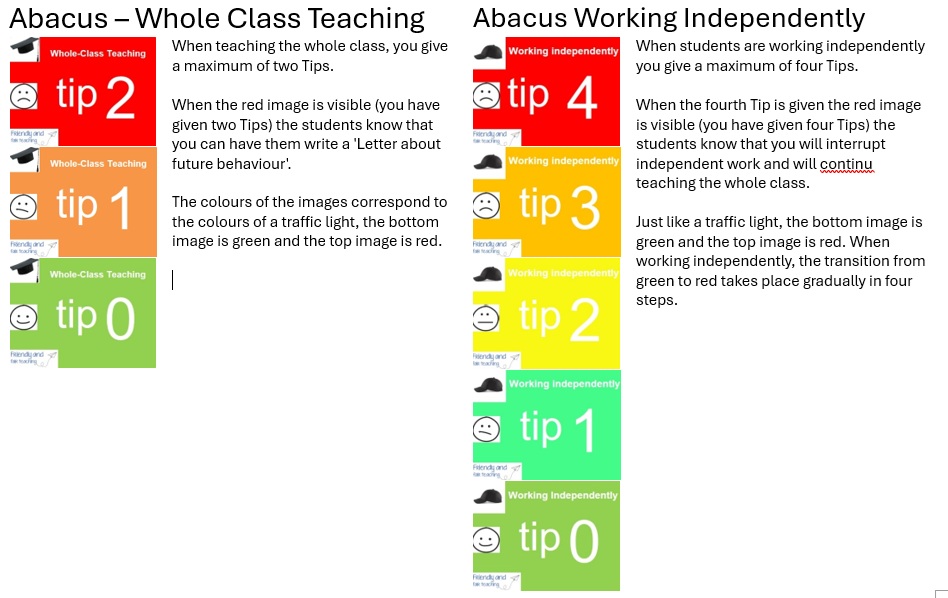
Image: Abacus – Traffic light
3. Start with Behaviour Management Strategies in two periods

Figure: components – Implementing Behaviour Management Strategies
Before you start, it is advisable to first gain experience in your lessons with the individual components of Friendly and Fair Teaching: the ‘Framework‘, the ‘Triangle‘, ‘Gestures‘, ‘Tips‘, and the ‘Future Behaviour Letter‘. Each component on its own contributes to a friendly and fair way of teaching.
The start of a new school year is an appropriate moment to begin the first phase of implementing FFT. This first phase is described as the ‘Practice Period‘. During this period, you introduce the first five components in an integrated way. The ‘Practice Period‘ is intended for teachers who do not yet have experience with ‘Behaviour Management Strategies‘. During this period you gain experience in giving and recording Tips. This record keeping limits the number of ‘Tips‘ per pupil per period to a maximum of two.
In a second phase, you introduce the sixth and final component—the Abacus—in one of the subsequent periods. Only begin using the ‘Abacus‘ once you have completed the ‘Practice Period‘. With the ‘Abacus‘, you add a second limitation. In addition to addressing each individual pupil’s behaviour and effort per period, in this next period, you shift responsibility from the individual pupil to the group as a whole. You limit the number of ‘Tips‘ for the entire group per lesson to:
- in whole-class teaching: a maximum of two Tips
- when pupils are working independently: a maximum of four Tips
4. Address a Student or the Group’s Behaviour and Commitment in Four Situations
Earlier, two teaching formats were discussed:
- ‘Teacher-Centred Education‘ / whole-class teaching
- ‘Student-Centred Education‘ / working independently
Two ways of addressing pupils were also discussed:
- Addressing an individual pupil regarding behaviour or commitment per period
- Addressing the group regarding behaviour or commitment per lesson
When you combine these two teaching formats with these two ways of addressing pupils, four situations arise in which you address behaviour or commitment:
- Whole-class teaching – Counting ‘Tips’ per pupil per period
- Working independently – Counting ‘Tips’ per pupil per period
- Whole-class teaching – Counting ‘Tips’ per group per lesson
- Working independently – Counting ‘Tips’ per group per lesson
The table below provides an overview of these four situations. At a glance, it shows the maximum number of ‘Tips‘ you give in each situation and which steps follow after the ‘Tips‘ .
4.1 Table: Approaches to Teaching / addressing behaviour
During the ‘Practice Period‘, and until the moment you introduce the ‘Abacus‘, you use only the green section of the table.
From the moment the ‘Abacus‘ has been introduced, you use both the green and the blue sections of the table. You then address both individual pupils and the group as a whole regarding behaviour or commitment.
Future Behaviour Letter printed on different coloured paper
The table includes advice to distribute the ‘Future Behaviour Letter‘ on different coloured paper when using the ‘Abacus’. See Preparing to introduce the Abacus

Figure: Table teaching format / addressing behaviour
5. Time Investment Behaviour Management Strategies for Teacher and pupil
Behaviour Management Strategies requires relatively little time and energy from you as a teacher. For pupils, the following distinction applies:
- When you address a pupil’s behaviour non-verbally or verbally, this does not take up any of the pupil’s time.
- When you address a pupil’s behaviour with the ‘Future Behaviour Letter‘, this does take up the pupil’s time.
Because writing a letter costs a pupil time, the non-verbal and verbal steps are effective. You will only notice this effectiveness after you have a completed and submitted letter in your possession. For this reason, during the ‘Practice Period‘ you give-if necessary-a pupil an assignment straight away in the very first lesson.
See also – Frequency: How Often do you Use the Steps of Behaviour Management Strategies.
6. Astrid Boon – Importance of Order
As an educational psychologist, Astrid Boon was acutely aware of the problems that arise when a teacher is unable to maintain order, and of the consequences this has for both teacher and pupil. She observed that teachers often resort to only two extremes when dealing with disruptive behaviour: issuing a warning or removing a pupil from the lesson. According to Boon, this approach lacks a series of effective intermediate steps.
FFT has developed this idea of intermediate steps into a three-steps structure:
non-verbal addressing, verbal addressing, and take action. FFT explains that these steps allow teachers to slow down disruptive behaviour gradually, preventing the need to “slam on the brakes” by removing a pupil from the lesson.
FFT advises introducing pupils first to the ‘Future Behaviour Letter‘ , and only then introducing the steps that precede the letter. Pupils then understand what addressing behaviour can ultimately lead to. If it becomes necessary to take action again in a subsequent period, you can choose an alternative measure, including Astrid Boon’s reflective report.
In her books, Astrid Boon describes the importance of order and explains why she recommends the use of her reflective writing task. In this video, she explains how this reflective assignment is structured.
In the video, Astrid explains the importance of order. Order is essential for both pupils and teachers.
7. Examples – Good Practice
Conversation between two pupils (A and B):
A: At the third Tip, you have to write a letter, and that’s not nice.
B: No, because then you have to be at school at eight o’clock the next day. You have to get up early, and that’s not nice.
A: It also takes quite a long time. That basically means you’re forced to pay attention.
B: Yes, exactly.
A: It’s not like with other subjects: you get sent out, you pick up a note, you leave the lesson, it doesn’t help at all.
B: If you’re sent out, you sit with other pupils and it’s actually quite fun. But I’m not really supposed to say that.
A: No, probably not.
Conversation betwee two pupils from the Pieter Nieuwland College in Amsterdam. They compare two ways in which teachers deal with classroom disruptions:
- removing a pupil from the lesson;
- asking a pupil to write a Future Behaviour Letter (referred to by the pupils as a reflective report, which was the name used at the time).
Their conclusion is that removing a pupil from the lesson does not work, whereas writing a ‘Future Behaviour Letter‘ is effective. In order to avoid having to write such a letter, pupils are motivated to pay attention.
7.1 Short Version of Behaviour Management Strategies

Karin receives her teaching qualification from FFT at the Maerlant Lyceum. See also this blog on how to obtain a teaching qualification.
Karin Seijdell explains how she applies ‘Behaviour Management Strategies‘ in her role as a teacher of Religious Education.
She focuses strongly on clear communication and on completing that communication effectively. For Karin, it is essential that when she is explaining something, pupils are genuinely listening.
If a pupil is not listening, she uses the ‘soft’ gesture with one arm. If the pupil responds positively, she gives a ‘compliment’ by raising her thumb.
If the pupil does not respond adequately, she asks the pupil to sit at the front of the classroom.
If the pupil continues to disrupt even there, she asks the pupil to write a ‘Future Behaviour Letter‘.
With this approach, she omits the use of ‘Tips’ and is able to address behaviour without involving senior leadership. If a pupil does not submit the letter, she seeks out the pupil during one of her free periods and—after obtaining permission from the teacher currently teaching the pupil—asks the pupil to complete the letter in her presence.
She uses the start gesture in combination with the technique of cold calling. Pupils are asked not to raise their hands; instead, she selects a pupil (using the start gesture) to answer the question, or selects another pupil to help or add to the answer.
8. Summary
First, prevent yourself from causing unrest (Reflecting on Teaching).
Address pupils consistently about behaviour or commitment, and make your professional boundaries clear (per period and/or per lesson)
The more clear you are, the less need there is to become angry.
Behaviour Management Strategies consists of the following three steps:
- Non-verbal: reinforcing positive behaviour through ‘Gestures‘, used as often as necessary.
- Verbal: reinforcig positive behaviour using ‘Tips‘, which you record on lists for whole-class teaching and working independently. When the maximum is reached—either by counting individual ‘Tips‘ or by counting per lesson using the ‘Abacus‘—you move to the next step.
- Action: Reinforcing positive behaviour with an assignment, using the ‘Future Behaviour Letter‘. You ensure that the letter is always submitted.
By using steps 1 and 2 effectively, you reduce the use of step 3. Steps 1 and 2 act as a buffer for step 3.
Finally
You may initially feel that ‘Behaviour Management Strategies‘ involves a great deal of administration. Experience shows that while it takes some time to get used to this approach, the number of disruptions quickly decreases. As disruptions decrease, the amount you need to record also reduces.
In practice, you will also encounter well-functioning groups for whom addressing pupils on behaviour or commitment is rarely, if ever, needed. When working with a restless group, however, recording ‘Tips‘ actually helps you build a stronger relationship with the group and reduces disruptions. Pupils pay better attention and achieve better results. How rewarding is it to build a positive relationship with every group you teach?
By addressing students on behaviour or commitment in a friendly way, you maintain a positive relationship with your pupils. In fact, after discussing a ‘Future Behaviour Letter‘ with a pupil, the relationship often improves (reframing).
If you start working at a school where pupils are already familiar with the FFT approach, it will be easy for you to adopt this way of working as well.
9. Credits
| Rense Houwing -Editor Friendly and Fair Teaching |
Rense introduced the distinction between the First steps (Non-verbal and Verbal) an the Next step (Action). Since then, Behaviour Management Strategies has been used as the title of the chapter on maintaining order. Thanks to Rense, Observing is now a separate, observation-focused perspective within Friendly and Fair Teaching. Observing precedes addressing students on behaviour or commitment. |
| Astrid Boon – Educational Psychologist | Through countless conversations with pupils, Astrid Boon identified the most effective measures for addressing behaviour. She discovered that pupils take tasks that cost them time seriously, whereas a “good conversation” or “warning and removing a pupil from the lesson” usually does not. She wrote two books on this topic: Punishment/Rules and Too Cosy in the Classroom.
She also made it clear that removing a pupil from the lesson should be a last resort. She advised introducing several smaller steps before using this ultimate measure. In collaboration with Astrid Boon, FFT shaped her ideas into Behaviour Management Strategies as a three-step approach. The effective element-the Action-is a task given to the pupil. See above: Astrid Boon – The importance of order. See also Alternative Measures, including a description of her reflective writing task and a video on the application of her approach in several schools. |