5.5 Complete Guide to Behaviour Management Strategies
On This Page
Teachers address pupils’ behaviour and commitment in three structured steps.
When I address a pupil about behaviour or commitment, I do so in a friendly manner. I work in a planned way and always follow the same three steps when addressing pupils.
Introduction Video
For more information check out our other introductory videos here.
1. Behaviour Management Strategies in Three Steps
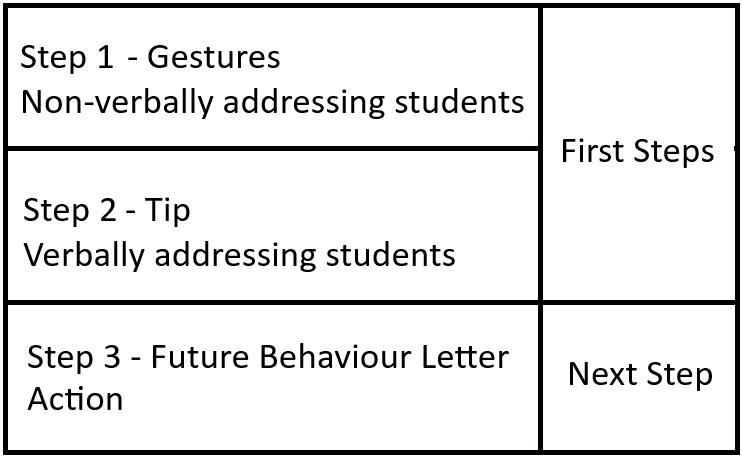
Figure: Guide Behaviour Management Strategies

Figure: Behaviour Management Strategies (overview)
When it is necessary to address a pupil about behaviour or effort, you proceed in a structured way. In a friendly manner (without becoming angry), you follow the three steps of Behaviour Management Strategies in the same order every time. Because you never act impulsively, the steps are effective. If a pupil does not respond well, you calmly move on to the next step.
1.1 Introducing the Three Steps
- You begin by applying the ideas of Friendly and Fair Teaching so that you become familiar with the idea that teaching can be friendly and fair.
- Ideally, you introduce the three steps as a coherent whole at the start of a new school year. However, it is also possible to start with Behaviour Management Strategies halfway through the school year. See Practice Period.
- Once this approach feels familiar and you want to take a further step towards even more effective classroom management, you introduce the Abacus.
Important: This guide only applies after you have implemented steps two and three.
2. Preventive – Curative
The three steps consist of preventive and curative actions.
- Preventive
With the first two steps (non-verbal and verbal), you delay taking a formal measure – issuing a Future Behaviour Letter. These first two steps act as a buffer, ensuring that you rarely need to take the third step. They prevent you from issuing the letter too often or too quickly. When the letter is used only occasionally as a means of addressing behaviour or effort, it retains its value. FFT therefore refers to the first two steps as preventive.
The first two steps do not cost a pupil any time, but pupils know that the third step does. As a result, they usually improve their behaviour at steps 1 or 2 in order to avoid step 3: writingFuture Behaviour Letter. - Currative
By addressing a pupil’s behaviour or effort through a Future Behaviour Letter, you resolve a problem. In most cases, the problem does not recur.
The third step costs the pupil time. Astrid Boon found that tasks which require time are effective. The letter is effective because it asks the pupil to reflect on improving their behaviour or effort and to help find a solution. Through the letter, pupil and teacher work together to resolve a problem. FFT refers to this lasting change in behaviour or effort as curative. The relationship between pupil and teacher improves, and everyone benefits from this ‘healing’: the pupil, teacher, classmates, parents and school leadership.
3. Complete Guide
Below, two columns show the similarities and differences in addressing behaviour and commitment during whole-class teaching and independent work. In both situations:
- A pupil may continue to seek attention even after you have given a Tip or asked the pupil to write a letter. Read how to deal with this in: Pupil continues to disrupt the lesson.
- A pupil may also miss the second opportunity to submit the task. Read how to ensure the task is submitted in: Always handing in the measure/task.
- You keep the letters. When a pupil writes you a letter, they express an intention. You can later remind the pupil of this intention. In your archive the colour of a letter indicates when you handed-out a letter.
-
Yellow paper: first letter issued during whole-class teaching
-
Orange paper: second letter issued during whole-class teaching
-
White paper: letters issued during independent work
Addressing Behaviour or Commitment when Whole-Class Teaching

Addressing Behaviour and commitment During Whole-Class Teaching
Teacher-centred education (whole-class teaching) is effective when you ask for attention calmly and explain without interruption. During whole-class teaching, you keep your ‘Tip Book’ to hand, with the blue ‘Triangle’ image on the back.
Step 1: Non-Verbal – First steps
You direct a pupil who is disrupting the lesson or not engaging with an exercise in a friendly manner:
- Pause your explanation. Stand still (relaxed) and look at the pupil kindly. If the pupil improves their behaviour, make the compliment gesture. If not:
- Take one step towards the pupil and look at them questioningly (eyebrows raised). If the behaviour improves, make the compliment gesture. If not:
- Depending on the disruption or lack of engagement, use one of the following gesture sequences: Attention – silence (stop talking), Attention – stop (stop what you are doing), Attention – start (meaning: join the exercise or start working).
- Show the pupil the blue side of the ‘Triangle’ or display the image on the back of your ‘Tip Book’.
If the pupil responds appropriately, give a compliment. If not:
Step 2: Verbal – First Steps
Take a step towards the pupil (do not stand directly opposite them) and clearly give a Tip that everyone can hear, such as: Please pay attention or Please take part in the exercise. Record the Tip in your Tip Book. Move the Abacus on by one page (up to a maximum of two Tips).
Step 3: Action – Next Step
You ask a pupil to write a Future Behaviour Letter:
- If the pupil’s name is written on the board, indicating that they have already received two ‘Tips’ earlier in the same period. On entry, you have already asked this pupil to pay attention.
- If the ‘Abacus’ shows that two ‘Tips’ have already been given during the lesson. Pupils who have never received a ‘Tip’ before know that they may now also be required to write a letter.
If a pupil disrupts the lesson or does not engage, you do not give a ‘Tip’ but ask the pupil Future Behaviour Letter. The first letter issued in a lesson is printed on yellow paper. If another letter is needed, a different pupil receives a letter printed on orange paper. You then interrupt the lesson and ask pupils to work silently on homework. Continuing to issue letters would reduce their effectiveness.
Addressing Behaviour or Commitment during Independent Work

Addressing Behaviour and Effort During Independent Work
Student-Centred Education (working independently) is effective when all pupils can work without interruption. During independent work, you observe pupils and move around with a clipboard holding the independent work list. On the back of the clipboard is the green ‘Triangle’ image.
Step 1: Non-Verbal – First Steps
You direct a pupil who is not working or who is disturbing a classmate as follows:
- Walk slowly and calmly towards the pupil and make eye contact. Move the independent work list on which you record Tips.
- Point to the green ‘Triangle’ image or show the image attached to the back of the clipboard.
- If the pupil responds well, give a compliment.
- If the pupil does not respond, use the gesture sequence attention – start, which asks the pupil to begin working. It is unnecessary to ask the pupil to stop disrupting; they already understand that they should be working.
If the behaviour improves, give a compliment. If not:
Step 2: Verbal – First Steps
Stand beside the pupil (not directly in front of them). In a quiet voice (so other pupils can continue working), give a positively phrased Tip: Please start working. Record the Tip immediately on the independent work list.
You count Tips given during independent work using the Abacus. The images 0, 1, 2 and 3 show the group whether independent work can continue. If the group stays within three Tips, pupils may continue working. If four Tips are given, independent work is no longer effective due to excessive disruption, and you return to whole-class teaching. When switching work formats, use the ‘Switching from working independently to whole-class teaching‘ gesture.
When you record a second ‘Tip’ for a pupil, inform them that the next step will be a letter and not a ‘Tip’.
Step 3: Action – Next Step
If the independent work list shows that a pupil has already received two ‘Tips’ in earlier lessons, you ask the pupil to write you a letter printed on white paper.
When issuing the task of writing a letter, choose one of the following options:
- Ask the pupil to place the letter in their bag, complete it outside the lesson, and submit it at an agreed time.
- Indicate when the pupil should report to you to write the letter.