
Introduction: Becoming a Friendly & Fair Teacher
On this page
- Parenting – Education
1.1 Preventive – Curative
1.2 Creating a Positive Learning Environment - The Five Perspectives of Friendly and Fair Teaching
2.1 Body Language: a Connecting Factor
2.2 Balance in the Five Perspectives - Impact on Society
3.1 Bildung und Wissenschaft - Removing and Overcoming Obstacles
4.1 Change
4.2 The Teacher’s Roles
4.3 Benefit from Collegues’ Experience
4.4 Pupils with Limited Impulse Control
4.5 Friendly and Fair Teaching Course
4.6 Friendly and Fair Teaching Interpretation
4.7 School-wide Implementation - Related Initiatives
5.1 The Liemer List
5.2 Peace Can Be Learned - Summary
- Credits
On this page, Friendly and Fair Teaching (FFT) provides a general introduction. This introduction is intended for teachers, primary school teachers, and trainee teachers.
With the five perspectives of Friendly and Fair Teaching, I create a positive learning environment.
Introduction video
For more information, please see our other introductory videos here.
Introduction to Friendly and Fair Teaching
Via the Tutorial tab, all the teaching materials of Friendly and Fair Teaching (FFT) can be accessed.
Please read these three introductory pages first before moving on to study the five perspectives of FFT:
- How Do I Become a Friendly and Clear Teacher? – general introduction to Friendly and Fair Teaching (this page)
- Stopping Getting Angry – the disadvantages of anger and the advantages of a friendly and fair approach
- Tutorial – explanation of the structure of the teaching materials
During Courses or Team Training sessions of Friendly and Fair Teaching, teachers respond to the FFT approach. Their experiences, and those of experts, are incorporated into this site. In this way, FFT continues to develop.
With this information, anyone who works in education—or plans to do so—can benefit from our materials without having to contact us directly. You can add the different components of FFT step by step to your own teaching practice. We share all information freely and without obligation. If you quote us, please include a source reference. If you have any questions, feel free to contact us.
On this page you will read about:
- the differences and similarities between parenting at home and teaching at school;
- how you can use preventive actions to avoid having to address pupils about behaviour or commitment;
- how, if necessary, you can address a pupil effectively about behaviour or commitment;
- what the five perspectives of Friendly and Fair Teaching can mean for your teaching practice;
- how to remove obstacles to change;
- how to introduce FFT to colleagues when it proves successful;
- how you can get started in a focused way with an FFT course;
- the FFT diploma: if you succeed in teaching in a friendly and fair way, you can obtain a Friendly and Fair Teaching diploma and set an example for others;
- how you can implement FFT across the whole school with a Team Training;
- the goals FFT aims to achieve through education.
You can add the different components of FFT step by step to your own way of teaching. Through this website, we share all information freely and without obligation. If you quote us, please include the source. If you have any questions, feel free to contact us.
1. Parenting – Education
There are strong similarities between raising children and leading a class.
In both cases, several adults work together. When they coordinate their roles well and cooperate, this has direct benefits for the child or pupil.Below, we discuss the two tasks that both play a role in education.
A friendly and fair teacher usually fulfils both.
Parenting in the family and in education
Anyone who is responsible for children deals with two responsibilities:
- Nurturing, care, and connection.
The focus is on physical and emotional well-being in the present moment and is therefore largely unconditional. Key words are: caring, empathetic, emotional, connected/connecting, friendly, and affirming. - Creating and maintaining structures and provisions.
What is needed or desired? What can we put in place? What do we need for that? How do we make it work and keep it working? What is everyone’s role or task? What are the rules, what must be done, and what is not allowed—and within which boundaries?
Key words are: rational, overarching, analytical, structuring, clear, setting boundaries, and enforcing.
In families with two parents, both parents are responsible for both tasks and can divide them between themselves. If there is only one parent, both responsibilities rest on that one person. This situation is comparable to that of a teacher: a teacher who stands alone in front of the class also carries both responsibilities.
Parenthood presents a special challenge, in the sense that the task of parents begins as pure protection and gradually has to change into a complex form of care that allows more and more space, without clear points indicating when and how such a transition should be initiated, or instructions on how to endure it.” Maggie Nelson (2022)
The same process—gradually letting go more and more—also takes place in education.
Standing alone
If, as a parent or teacher, you are on your own, the roles described above may not come naturally to you. If you give too little attention to one of the two roles, you may become either:
- Too permissive.
You focus solely on the caring, empathetic, friendly role. If clarity is lacking—perhaps out of fear of confrontation—you become too permissive, and children/pupils miss clear boundaries. - Too rational or strict.
You focus solely on the rational, structuring, and boundary-setting role. If care is lacking and strictness dominates, the relationship between you and the pupils becomes distant. You may do this out of fear of appearing vulnerable. Children/pupils then do not feel connected to you and are less inclined to align themselves with your needs or those of the family/group.
In both cases, this leads to unrest. If one of these roles is underdeveloped in your teaching, pupils will cross boundaries at the expense of you and the group.
A task specific to teachers and schools
The school has precisely the task of teaching the child that the family, however necessary it is for their development, is not their only frame of reference—and cannot be. For it is at school that we discover that other children live differently; that not all parents react in the same way; that not everyone believes in the same gods; that not everyone’s concerns are the same; and that the opinion of some is not the opinion of all.” Meirieu, Letter to the Beginning Teacher
1.1 Preventive – Curative
Most of FFT’s advice is preventive in nature. By applying this advice, you prevent disruptions and ensure that pupils remain engaged. You allow pupils a limited margin to disrupt the lesson (preventive). It then rarely becomes necessary to intervene with a measure (curative).

Figure 11: Preventive and Curative
The distinction between preventive and curative is shown as follows:
Preventive: shown in italics
Curative: shown in bold
With FFT, you ensure that you:
- do not create unrest yourself;
- use friendliness as an effective tool;
- replace being too permissive or too strict with being friendly and fair;
- alternate between ‘Teacher-Centred Education’ (informing) and ‘Student-Centred Education’ (experiencing);
- motivate pupils and help them to concentrate;
- guide and adjust the learning process in a friendly and relaxed way.
Note that the preventive part is much larger than the curative part.
1.2 Creating a Positive Learning Environment
A friendly and fair teacher understands the importance of three core components of a good lesson: structure, freedom, and responsibility.
Structure
Within a clear structure, pupils can flourish. FFT helps you to create structure and offers the following advice:
- Read the guide for the initial period in which you start working with FFT: see ‘Practice Period‘
- Alternate whole-class teaching with moments when pupils work independently. See ‘Planning Lessons‘ and, among other things, watch the video about how the brain works.
- Give pupils the opportunity to assess themselves.
- Involve pupils in evaluating your way of working—mutual evaluation strengthens cooperation.
- Set a good example and be aware of your influence as a teacher.
Freedom
A clear structure makes it possible to give pupils a certain degree of freedom. During independent work, you offer assignments you have prepared and also give pupils space to devise and carry out their own tasks. This increases their intrinsic motivation and enables pupils to:
discover and develop themselves;
work at their own pace;
make choices and set goals.
Responsibility
During independent work, you ask your pupils to handle the freedom offered in a responsible way. If a pupil finds this difficult, it is your task to coach him or her.
When a core component is missing
When one of the three core components receives too little attention, the effectiveness of education decreases:
- Without structure, education is not efficient.
- Without freedom, it is not challenging.
- Without responsibility, pupils do not develop independence.
Positive learning environment
The more positive your learning environment, the less often it is necessary to reinforce positive behaviour. Pupils know where they stand, feel seen, and are more likely to take responsibility for their behaviour.
In a positive learning environment, every pupil gets the chance to gradually develop into a social, intrinsically motivated learner who takes responsibility, makes choices, and can guide both themselves and others.
2. The Five Perspectives of Friendly and Fair Teaching
Friendly and Fair Teaching divides all aspects of education into five perspectives. Together, they form a practical framework for mapping and improving your teaching practice: Establishing a Friendly Tone, Establishing Fairness, Planning Lessons, Observing Learning, Behaviour Management Strategies.
How do you apply these perspectives?
FFT invites you to become familiar with these five perspectives. They offer concrete points of reference that help improve your own behaviour as well as the behaviour and effort of your pupils. With FFT, you create a positive learning environment step by step.
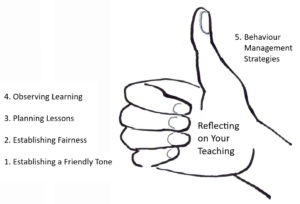
Figure: Five perspectives FFT
In the illustration, you can see the five perspectives of Friendly and Fair Teaching. In this image, the perspective ‘Establishing a Friendly Tone’ is placed at the bottom. This is a deliberate choice, because a friendly attitude forms the foundation on which everything rests. All perspectives fall under ‘Reflecting on Your Teaching’. A friendly and Fair teacher pays attention to all five perspectives.
First Perspective of FFT: Establishing a Friendly Tone
A friendly attitude forms the basis of good teaching. Just as anger throws you off balance in a martial art, anger also disrupts education. By remaining friendly, you prevent conflicts and maintain calm in the classroom.
By consistently staying friendly, you prevent escalation and preserve a calm classroom climate.
With a non-violent approach, parents and children look for what they have in common and for reasons to help and support one another. Parents accept that the shortcomings of children probably arise from the shortcomings of the parents themselves.” Arun Gandhi (2017)
Second Perspective of FFT: Establishing Fairness
Fairness prevents misunderstandings and unrest. When pupils know what you expect from them, they can work more purposefully and take more responsibility. With the Framework on the wall (Friendly and Fair) and with the Triangle (see images below), you provide structure and direction. See the perspective ‘Establishing Fairness’.
Third Perspective of FFT: Planning Lessons
A good lesson alternates between:
- Teacher-Centred Education (whole-class teaching): you introduce and practise new content in whole-class moments (informing).
- Student-Centred Education (independent work): you enable pupils to work independently (experiencing).

Figure: Alternating whole-class teaching with independent work
A brief explanation of the following quote: only Teacher-Centred Education can lead to too much order. Only Student-Centred Education can lead to too much disorder.
Too much disorder is directly dangerous. Too much order makes us vulnerable in the long term, because adaptability and creativity then decline.” Mark Mieras
You encourage contact between pupils by deliberately varying pairs and groups during whole-class lessons. During independent work, you give pupils the freedom to decide for themselves with whom they work.
During independent work, you guide pupils discreetly and in a coaching manner, so that they develop ownership and the rest of the class can continue working undisturbed. You also regularly reflect on your teaching, using feedback from colleagues, school leaders, and pupils.
Fourth Perspective of FFT: Observing
By being alert to both language and body language, you recognise early signs of unrest. This allows you to intervene subtly before a situation escalates. Observing helps you to act preventively and to reinforce positive behaviour calmly. By observing, you quickly see what an individual pupil needs.
Fifth Perspective of FFT: Behaviour Management Strategies
When several pupils display behaviour you find undesirable, this can lead to anger. Friendly and Fair Teaching shows you how to reinforce positive behaviour effectively. In doing so, you prevent anger. Before you start with the perspective ‘Behaviour Management Strategies’, first read the page ‘Stop Getting Angry’.
2.1 Body Language: a Connecting Factor
Body language is important in all perspectives:
- Establishing a Friendly Tone: You use body language in a positive, open way—without looking angry.
- Establishing Fairness: You make clear gestures, without appearing strict.
- Lesson Content: When you switch from independent work to whole-class teaching, you use both a gesture and a clear voice.
- Observing: By observing carefully, you see more quickly what is going well, what pupils need, and whether it is necessary to reinforce positive behaviour.
- Behaviour Management Strategies: Reinforcing positive behaviour always starts with body language. Body language is your most important instrument here.
See also the overarching chapter ‘Using Body Language: Advice for Teachers‘
2.2 Balance in the Five Perspectives
The five perspectives together form a chain of five links.
If one link weakens, your teaching loses its strength:
- Without Establishing a Friendly Tone, there is no good atmosphere.
- Without Establishing Fairness, there is no trust.
- Without a balance between Teacher-Centred Education and Student-Centred Education, your ‘Planning Lessons’ becomes one-sided.
- Without ‘Observing Learning’, you miss important signals.
- Without ‘Behaviour Management Strategies’, the number of disruptions increases and you lose grip on the learning process.

Figure 2: Chain FFT
Each link is vital for the proper functioning of education. The colours are taken from a traffic light. With everything that is green, you prevent disruptions. With the First Steps and the Next Step (Behaviour Management Strategies), using the colours orange and red, you reinforce positive behaviour in this order:
- First non-verbal and then verbal (orange).
- Then—if necessary—you confront a pupil with an action (red).
When you combine the five perspectives, a positive learning environment emerges and you teach with pleasure. Pupils notice that you see them, are motivated, and take responsibility. A balance between the group and the individual is not only educationally important, but also socially significant, as this quote shows:
The balance between group identity and individuality is the key to successful social systems.” Christakis (2019)
On this page ‘Checklist for Motivational Coach‘, you will find a list of questions you can ask yourself from time to time to monitor and guide your development.
3. Impact on Society
A Close-Knit Community
What you achieve as a teacher in a classroom resonates in society when:
- not only you as a teacher, but the entire school team strives to form a close-knit community together;
- pupils look back on a school period in which they were treated in a friendly and fair way by their teachers, fellow pupils, and other staff;
- the school provides sufficient structure and pupils are given space to develop their own initiatives;
- teachers recognise the specific needs of pupils;
- where necessary positive behaviour is reinforced effectively;
- pupils develop into independent citizens who later make a valuable contribution to society.
In this way, a school not only shapes its own culture, but also the society of the future. This broader view of education closely aligns with Gert Biesta’s threefold aim:
Qualification
Qualification plays an important role in education, because good qualifications increase pupils’ opportunities. With the important caveat that one person’s success should not come at the expense of another.
That is why FFT advises paying explicit attention—not only to Qualification—but also to Socialisation and Subjectivation. This threefold divisionwas developed by Gert Biesta. Read his explanation of these educational aims and see how FFT has slightly adapted the definitions so that they can be applied more generally. FFT’s ambition is to anchor these aims firmly in education first, and then also in society.
3.1 Bildung und Wissenschaft
The vision of FFT connects with a longer pedagogical and philosophical tradition. In the following quote, Sue Prideaux discusses Humboldt’s ideas about Bildung and Wissenschaft. In this view, too, education is not about reproducing knowledge, but about the development of the human being in relation to the world.
Human Potential
The ultimate goal of schooling was ‘a complete education for the human personality[…] the highest and most appropriate development of the individual’s faculties into a complete and coherent whole.’ This complete and coherent whole was a combination of two typically German ideals: ‘Wissenschaft’ and ‘Bildung’. ‘Wissenschaft’ was the idea of studying as a dynamic process constantly renewed and enriched by scientific research and independent thinking, so that each student contributed to the endlessly advancing sum of knowledge. It was the exact opposite of memorizing things.
Knowledge was considered evolutionary in nature, and with it went ‘Bildung’, the evolution of the order seeker himself: a process of spiritual growth through the acquisition of knowledge that Humboldt described as a harmonious interaction between the student’s own personality and nature that culminated in a state of inner freedom and wholeness within a larger context.” Prideaux (2018), Sue
Letting Go of Assumptions
This view of learning also requires letting go of certainties. As Carlo Rovelli puts it:
To learn anything, it is necessary to dare to accept that what we think we know – including our most deeply held beliefs – may be wrong, or at least naive: shadows on the walls of Plato’s cave.” Rovelli (2014), Carlo
Friendly and Fair Teaching also sees knowledge as something that is constantly evolving:
- Through courses and team training, collaboration with schools, and the study of literature, new insights continually emerge within FFT.
- These insights lead us to let go of old assumptions and develop new ones.
- The speed of this development is visible in our annually updated course book.
- Friendly and Fair Teaching supports teachers in their ongoing professional and personal development.
4. Removing and Overcoming Obstacles
4.1 Change
Change is difficult, but you are not on your own, and you can take it step by step. Perseverance and persistence are essential for real change. During any change process, you will encounter obstacles such as:
- attachment to a familiar role or behaviour pattern;
- automatically slipping into a role you do not actually want to take on.
Everyone recognises this: you know how valuable it can be to behave differently, but your current behaviour feels like an old jacket that fits perfectly.
Change, however rewarding, always brings discomfort. Saying goodbye to old habits, making mistakes, uncertainty, resistance, and setbacks are all part of it. These side effects make it tempting to abandon change or to return quickly to old patterns as soon as things become difficult.
Precisely then, it is important to persevere and keep going.
4.2 The Teacher’s Roles
The following six roles that you fulfil as a teacher are widely recognised in education:
- Host
- Presenter
- Didactician
- Pedagogue
- Coach
- Closer
Friendly and Fair Teaching also distinguishes two additional roles:
In an interview, Dick Bruinzeel uses the metaphor: “From an organised journey to a personal trek.” This implies a gradual shift in emphasis: from a shared, organised journey to an increasingly personal trek for each pupil. The older the pupil, the more responsibility he or she can carry. The roles below are an elaboration of Dick Bruinzeel’s interview.
- Tour leader of an organised journey
(Teacher-Centred Education – whole-class teaching)
This role emphasises the importance of the guidance you provide. - Roadside assistance
(Student-Centred Education – independent work)
During independent work, pupils undertake a (figurative) trek. At that time, you fulfil the role of Roadside assistance for your pupils. Read more about how this role is further differentiated into Coach, Gardener, Designer of a pedagogical context, Midwife, and Detective.

Figure: Trek
Motivation Coach – another name for a teacher
The term Motivation Coach was coined by a course participant and further developed by FFT. The accompanying questionnaire helps you to develop your teaching practice.
4.3 Benefit from Colleagues’ Experience
Friendly and Fair Teaching in the Classroom offers a wide range of new behavioural and role options. These bring many benefits, but also the challenges that come with change. Take a look at these testimonials and videos in which colleagues describe their experiences and changes:
- Testimonials as news articles
- Testimonials as videos
A frequently heard piece of advice from colleagues
You will often hear colleagues say: “Start strict and then gradually loosen the reins.”
Read in the ‘Practice Period‘ how this principle also plays a role within Friendly and Fair Teaching (but without getting angry).
Credits
Important new insights within Friendly and Fair Teaching often come from course participants and experts. At the bottom of each perspective, we mention who has contributed a new insight under the heading ‘Credits’.
4.4 Pupils with Limited Impulse Control
With a friendly and fair attitude, you achieve more with pupils who have limited impulse control. These pupils do want to do what you ask, but they get caught up in their own impulses. When you guide them kindly using gestures and body language, you avoid constantly mentioning their name in negative situations. By remaining friendly, you reassure them, give them confidence, and support them in their efforts to behave better.
Agree on a personal gesture with the pupil by which:
- you indicate that the pupil is becoming too restless (for example, by pointing to a place where the pupil can calm down for a moment);
- the pupil indicates that the lesson is becoming too busy (so that you can, if possible, reduce the level of stimulation);
- the pupil asks for help (agreeing that, as soon as you have time, you will discuss what is going on).
If gestures do not work, you can ask (outside the group):
“Where do you think you would be able to concentrate best in this classroom?”
Then, where possible, arrange the place the pupil suggests. Afterwards, discuss how it went and adjust the place if necessary.
Other options:
- Give the pupil a place at the back of the classroom. This gives them an overview and means they do not have to keep turning around. It often helps to see others working in a focused way.
- In primary school, a Year 6 teacher once made a small “den” under her desk where a pupil could retreat when the class became too busy.
- Let the pupil occasionally work outside the classroom, preferably under supervision.
- If the school has a library or media centre, let the pupil work there from time to time.
- If the pupil has too much energy, let them take a short walk.
- At the start of the lesson, ask:
“What goal do you set yourself for this lesson? Do you think you can achieve it?”
Afterwards, you can discuss together:
- What went well? Why did that work?
- What did not go well? What was the cause?
Tips for pupils with limited impulse control:
- Read the blog about the film Les Choristes.
- Give these pupils a personal, achievable task that connects with their talents, so that they can experience success.
- Occasionally give them a specific responsibility, such as fetching coffee, handing out materials, or putting up posters.
4.5 Friendly and Fair Teaching Course
Over the years, Friendly and Fair Teaching has gathered a great deal of information that can help teachers, educators, and students to teach in a friendly and fair way. A good way to get started is by taking a Course.
4.6 Friendly and Fair Teaching Interpretation
Implementing improvements is a challenge and requires courage and perseverance. Successful improvements benefit both your pupils and yourself: they increase both job satisfaction and the effectiveness of your teaching.
In practice, every teacher gives Friendly and Fair Teaching their own personal interpretation. If this interpretation is also useful for others, we publish it under the heading ‘Examples’.
4.7 School-wide Implementation
When succesful with FFT you can inspire other colleagues to explore Friendly and Fair Teaching. When that succeeds, the time has come to involve school leadership and parents as well. Consider organising a Friendly and Fair Teaching Team Training to set this process in motion (see Implementing School-Wide).
The initiative for implementing FFT can come from teachers, school leaders, pupils, students, teacher training institutes, parents, or educational support staff. See also the higher education news items.
5. Related Initiatives
Friendly and Fair Teaching does not stand on its own. Over the years, we have been inspired by various initiatives and thinkers with whom we feel a close affinity.
5.1 The Liemer List
The Liemer List originated from hundreds of conversations with primary school pupils (in the Arnhem region) about how they learn best. In a broader sense, the Seven Promises express mutual trust and shared expectations between pupils, teachers, school leaders and support staff — and give everyone the space to fulfil those expectations.
FFT advises participants in our Courses and Team Training sessions to teach with these intentions in mind:
- We see who you are, and you notice we believe in you;
- We have grand expectations of each other;
- Learning is fun and can happen anywhere;
- Your learning environment is engaging, inspiring and challenging;
- You always have a choice;
- If we can do it together, we do not do it alone;
- You know what you need to learn and what you can do with it.
5.2 Peace Can Be Learned
Friendly and Fair Teaching recognises itself in the booklet Can Be Learned (Reybrouck, 2017). That is why we give this booklet as a gift during courses in the Netherlands and use it several times during the course as a source of inspiration.
6. Summary
Friendly and Fair Teaching is rooted in a broader pedagogical tradition, is practice-oriented, and continues to develop through collaboration and reflection.
A friendly and fair teacher:
- informs pupils in the first lesson about expectations regarding behaviour and commitment using the Framework and the Triangle, and announces the intention to stop getting angry (see Stop Getting Angry);
- reflects on his or her teaching and introduces new elements into existing practice where necessary;
- notices over time that pupils become accustomed to the new approach and that cooperation between pupil and teacher improves;
- involves colleagues in trying out Friendly and Fair Teaching.
What can you expect?
Bear in mind that the composition of a group can sometimes make teaching more challenging. With patience and consistent reinforcing of positive behaviour, you can also work well with such a group over time.
And sometimes you are lucky enough to have a cooperative group—then reinforcing positive behaviour is hardly necessary.
7. Credits
Gert Biesta –
Professor of Public Education, Maynooth University, Ireland
Professor of Educational Theory and Pedagogy, University of Edinburgh
Gert Biesta advised us to place the emphasis on Creating Order. As he puts it:
“Who is actually responsible for order in the classroom? And is it not more about creating and providing order than about maintaining order?”
He also pointed out that, in an earlier phase, we focused too one-sidedly on Student-Centred Education. Following his advice, FFT has sought a balance between Student-Centred and Teacher-Centred Education.
Rense Houwing
In an earlier phase, Rense edited the entire FFT website. He pointed out that paying attention to body language and language use fell outside the action-oriented perspectives. We now group both ways of observing together under the heading ‘Observing’. He also introduced the distinction within Behaviour Management Strategies between First Steps (which costs the pupil no time) and Next Step a(which does cost the pupil time).
José Caballero – Chemistry teacher and Chair of the Friendly and Fair Teaching Foundation
José drew our attention to the importance of trust:
“Raising children is about letting go. You can only let your pupils go if you trust them.”
Jan Wolters – Music teacher and teacher educator at the conservatoire
Jan emphasised that it is the teacher’s task to address pupils about behaviour and effort—that is part of the profession.
He also advised us to replace the term Assessment with Student-Centred Education.
Finally, he pointed out:
“If it comes to maintaining order, you are already too late.”
This argues for organising education in such a way that order arises naturally and maintaining order is hardly necessary.